

Carpal Orthosis for Dogs
Custom-designed veterinary orthotic devices to stabilize the canine carpal joint and support controlled, functional movement.
Carpal orthoses are veterinary medical devices designed to support and stabilize the canine carpal joint (wrist) in cases of instability, injury, or chronic joint dysfunction.
When properly designed and fitted, a carpal brace can help improve limb alignment, support weight-bearing, and reduce abnormal joint loading.

Clinical Indications for a Carpal Orthosis
A carpal orthosis may be considered in the following situations:
carpal hyperextension injuries
ligament damage affecting the carpal joint
post-traumatic or chronic carpal instability
post-operative joint support
degenerative joint conditions requiring stabilization
neurological conditions affecting carpal control
Each case should be evaluated by a veterinary professional to determine suitability.
Functions of the Carpal (Wrist) Orthosis
The carpal orthosis is designed to provide targeted stabilization of the canine thoracic limb at the level of the carpal (wrist) joint. As dogs bear approximately 60% of their body weight on the forelimbs, the carpus is a highly loaded and biomechanically complex joint, subjected to significant stress during both movement and static weight-bearing.
The canine carpus is composed of multiple small bones interconnected by ligamentous structures and supported by surrounding soft tissues. Injury or instability in this region can substantially affect limb alignment and gait mechanics, often leading to compensatory loading of the contralateral limb and altered muscle chain function, with an increased risk of secondary strain or injury.
A properly designed and fitted carpal orthosis helps stabilize the joint, control excessive or abnormal motion, and support functional weight-bearing. By improving joint alignment and movement control, the orthosis may also contribute to pain reduction and support tissue recovery as part of a comprehensive treatment or rehabilitation plan.
By limiting abnormal joint motion and supporting more symmetrical gait patterns, a carpal brace can help reduce compensatory overload of other limbs and joints, thereby lowering the risk of secondary musculoskeletal strain over time.
Carpal orthoses may also be suitable for selected feline patients. Suitability for use in cats must be evaluated individually, taking into account the animal's health status, anatomy, and specific clinical needs. Consultation is required prior to application.
Who Is a Carpal Orthosis Intended For?
A carpal orthosis may be considered for dogs requiring stabilization and controlled support of the carpal (wrist) joint in a range of clinical situations, including:
Post-operative joint stabilization
Following surgical intervention, a carpal orthosis may be used to support the wrist joint during healing and to help limit excessive or undesired motion.Conservative management prior to surgery
In cases where surgical intervention (such as carpal arthrodesis) is being considered but is not yet indicated, a carpal brace may provide temporary stabilization and support as part of a conservative treatment approach.Support during post-surgical recovery
Orthotic support can assist controlled loading of the limb while tissues heal and function is gradually restored.Support of the contralateral limb after amputation
In dogs that have undergone full limb amputation and are not suitable candidates for a full limb prosthesis, a carpal orthosis may be recommended to support the remaining thoracic limb and reduce compensatory overload.Carpal hyperextension injuries
In dogs affected by carpal hyperextension, a carpal orthosis helps limit excessive extension of the joint and supports more stable limb positioning during stance and gait.Congenital deformities and developmental conditions
When congenital or developmental abnormalities affect carpal stability, orthotic support may help improve alignment and functional use of the limb.Brachial plexus nerve injury
In cases of brachial plexus injury, stabilization of the carpal joint can support controlled limb placement, improve weight-bearing ability, and help reduce excessive strain on muscles and tendons during recovery.
Each case is individually assessed to determine whether a carpal orthotic solution is clinically appropriate and aligned with the dog's overall condition and treatment plan.
Custom Carpal Orthosis – Design Options
Our custom carpal orthoses are available in different design configurations, selected based on the animal's diagnosis, functional needs, and biomechanical requirements. Each brace is individually designed to provide appropriate stabilization while preserving as much natural movement as clinically indicated.
Carpal Orthosis – Caudal Fastening (Palmar Support)
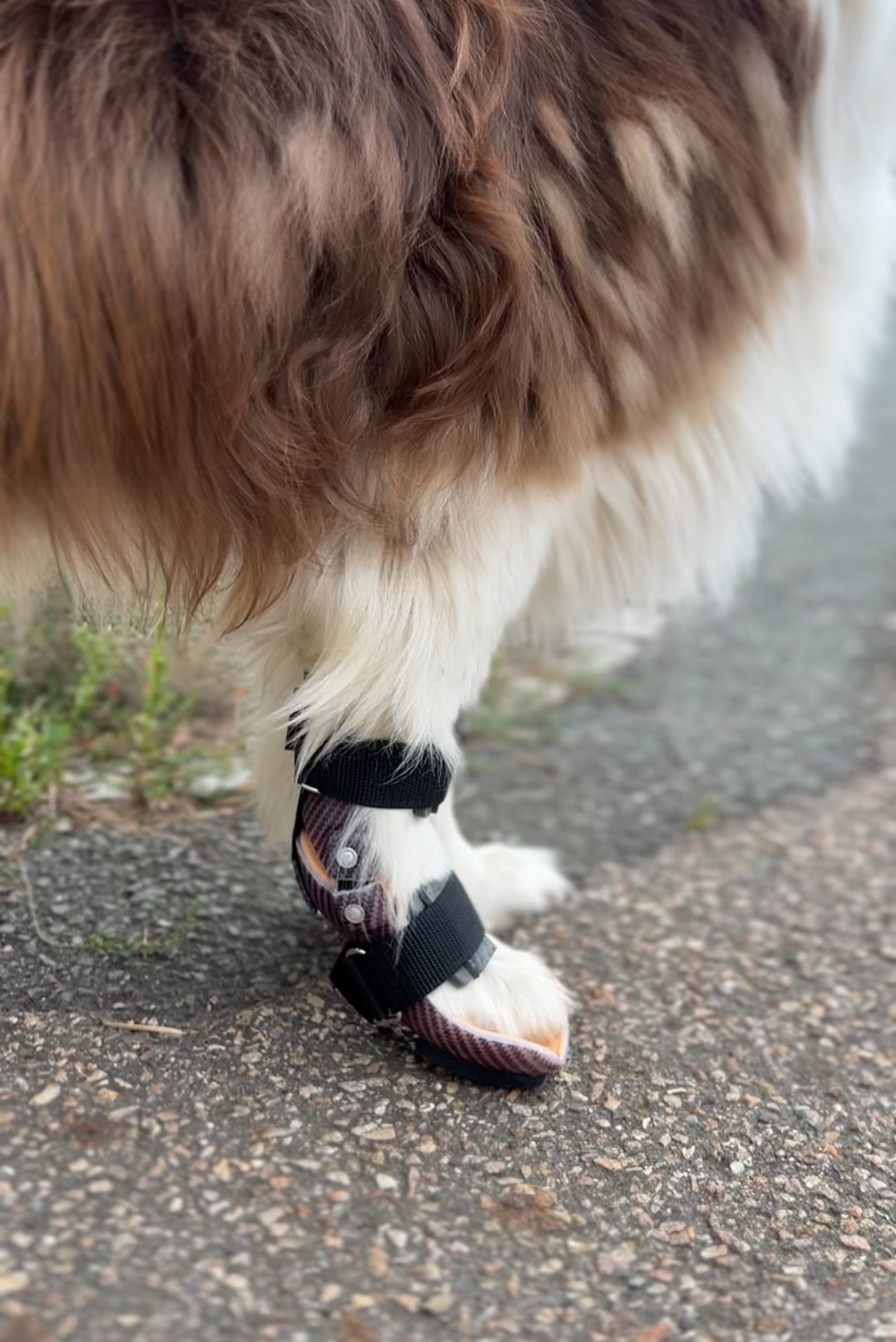
This carpal orthosis features a caudal (palmar) fastening system, applied from underneath the paw. It is designed to support and stabilize weakened or injured carpal structures while allowing functional limb use during recovery.
The orthosis allows controlled flexion of the carpal joint while limiting hyperextension during weight-bearing, particularly at ground contact. A fastening strap positioned near the joint on the caudal aspect enables adjustment of the range of motion according to clinical requirements.
Depending on the individual case, this design can also be manufactured without allowing joint flexion, providing increased rigidity when greater stabilization is required.
This configuration is often suitable for cases such as:
carpal hyperextension
soft tissue or ligament injuries
paw pad injuries requiring controlled limb support
For more complex neurological conditions, such as brachial plexus injury, where the entire thoracic limb requires more comprehensive stabilization, an alternative orthotic approach is typically recommended.
Carpal Orthosis – Cranial Fastening (Dorsal Support)
This variant is applied from the cranial (dorsal) aspect of the limb and provides targeted stabilization of the carpal joint while protecting it from further injury.
The design allows controlled joint flexion while effectively preventing hyperextension during stance and gait. A key advantage of this configuration is that the dog's paw remains free within the brace, allowing direct ground contact and preservation of proprioceptive feedback, which is essential for coordinated movement.
The distal edge of the orthosis is reinforced with high-quality padding to minimize friction and reduce the risk of skin irritation around the toes. Carefully selected materials and an ergonomic design make this variant suitable for long-term wear and ongoing rehabilitation.
Pricelist
The price depends on the size of the animal (the prices are final, including the cast kit, including transport in Europe).
Orthosis with bend (semi-rigid):
< 0 - 15 kg
800 EUR
Orthosis with bend (semi-rigid):
15 - 35 kg
875 EUR
Orthosis with bend (semi-rigid):
< 35 kg and more
950 EUR
Additional parts for extra charge:
Top cover / wrist pocket / other custom modifications
85 EUR
Orthosis without bending (rigid):
< 0 - 15 kg
700 EUR
Orthosis without bending (rigid):
15 - 35 kg
800 EUR
Orthosis without bending (rigid):
< 35 kg and more
875 EUR
Additional parts for extra charge:
Top cover / wrist pocket / other custom modifications
85 EUR

Clinical Goals of a Carpal Brace
A properly designed carpal orthosis aims to:
stabilize the carpal joint
control range of motion where needed
support functional weight-bearing
improve limb alignment during stance and gait
reduce compensatory overload of adjacent joints
assist pain-free and controlled movement
Orthoses are intended to support existing anatomy, not replace it.

Why Carpal Orthoses Require Custom Design
The canine carpus is a complex joint subjected to significant load during movement.
Effective orthotic support requires:
precise anatomical fit
correct alignment of the joint axis
controlled stabilization without excessive restriction
careful pressure distribution to protect soft tissues
Generic or poorly fitted braces may fail to provide adequate support and can increase discomfort or secondary strain.

Custom Carpal Orthosis — Designed Case by Case
Each carpal brace is individually developed based on:
veterinary assessment and diagnosis
limb measurements and joint geometry
gait and functional analysis
soft tissue condition and tolerance
activity level and rehabilitation goals
No off-the-shelf solutions are used.
Each orthosis is a case-specific biomechanical solution.

Our Orthotic Development Process
Veterinary Case Review
Diagnosis, imaging, and functional assessmentLimb Measurement & Analysis
Joint alignment, geometry, and load evaluationCustom Design & Fabrication
CAD-based orthotic design using medical-grade materialsFitting & Functional Testing
Comfort, alignment, and controlled motion assessmentFollow-Up & Adjustments
Monitoring adaptation and optimizing long-term function
Carpal Orthosis vs. Other Treatment Options
Option
- Carpal orthosis
- Surgical intervention
- Conservative management
- Prosthetic solutions
Purpose
- Stabilizes the joint and controls motion
- Structural repair when indicated
- Rest, medication, rehabilitation
- Not indicated for carpal instability
Orthotic support may be used as a primary solution or as part of a broader treatment plan, depending on clinical indication.

Who Can Benefit from a Carpal Orthosis?
Pet owners
dogs with carpal instability or hyperextension
dogs requiring post-injury or post-surgical support
dogs needing controlled joint stabilization
Veterinary professionals
orthopedic case management
rehabilitation and conservative treatment planning
long-term joint support strategies

Discuss Whether a Carpal Orthosis Is the Right Solution
Please describe your situation. Additionally, provide information about the animal (species, breed, weight, age), and if possible, also include a photo of the animal.